Bruce Springsteen’s Chimes of Freedom
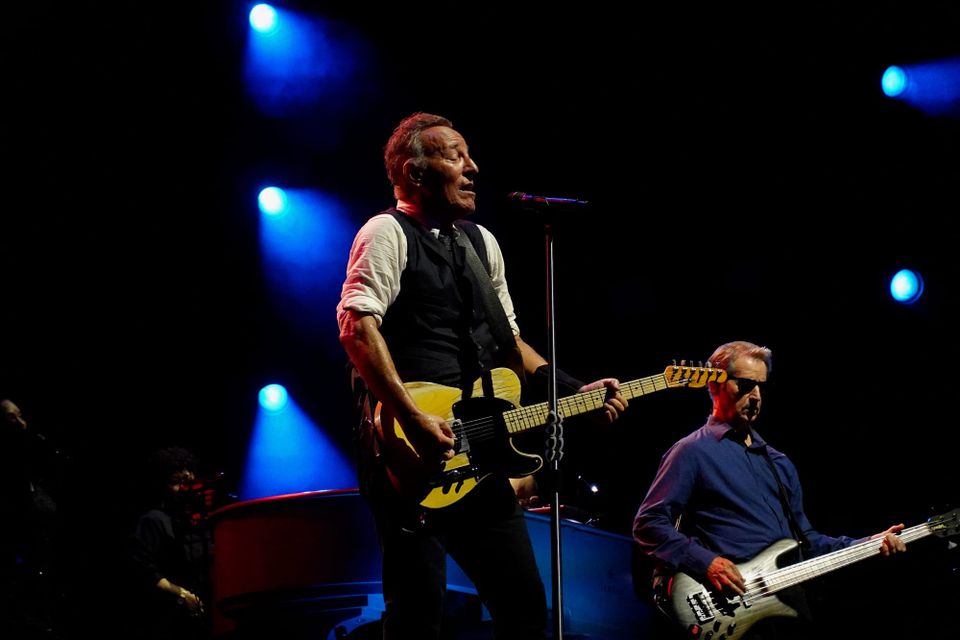
In line before the first of two Bruce Springsteen concerts in San Sebastián, Spain last summer a gentleman with whom I had been chatting asked where I was from. When I told him I live in San Francisco, he smiled a little and said “San Francisco. That’s a great city for freedom. It has a great history, no?” We talked on and off for a couple of hours, about the show we were both excited to see; about strategies for surviving a several-hour wait in the hot sun; about my country and his. He told me America had always been a beacon of hope and freedom to him, his words accompanied by a facial expression and tone of voice that carried a question: What is it now? I didn’t have a good response, and mumbled something about thinking maybe it was our time to draw inspiration from outside our borders.
I thought of that unspoken question that evening, towards the end of a nearly-five-minute speech in which Springsteen excoriated “the abuses of an unfit president and a rogue government,” that is “persecuting people for using their right for free speech” and “rolling back historic civil rights legislation that led to a more just society” and “siding with dictators against those struggling for their freedom” and “removing residents off of American streets and without due process of law deporting them to foreign detention centers and prisons,” a litany of abuses so anathema to “what it means to be deeply American” that Springsteen felt compelled to insist: “The America that I’ve sung to you about for fifty years is real.”
For the ten months since that show, two questions have kept swirling around in my mind: What is that America, and is it real? And Is this tour the greatest thing Bruce Springsteen has ever done?
I’ve been struggling to articulate some thoughts connected to those two questions for weeks. Here is the best I can do. It’s long. It’s more a collage of thoughts than a single essay.1
Public Service Announcement … With Guitar
During the 2004 Vote for Change concert tour Springsteen headlined, he introduced his nightly political comments near the end of each night’s set with a slightly self-conscious, tongue-in-cheek acknowledgement that many in the audience might not have been there primarily for a political rally: “And now, the moment everyone's been waiting for: my Public Service Announcement!”
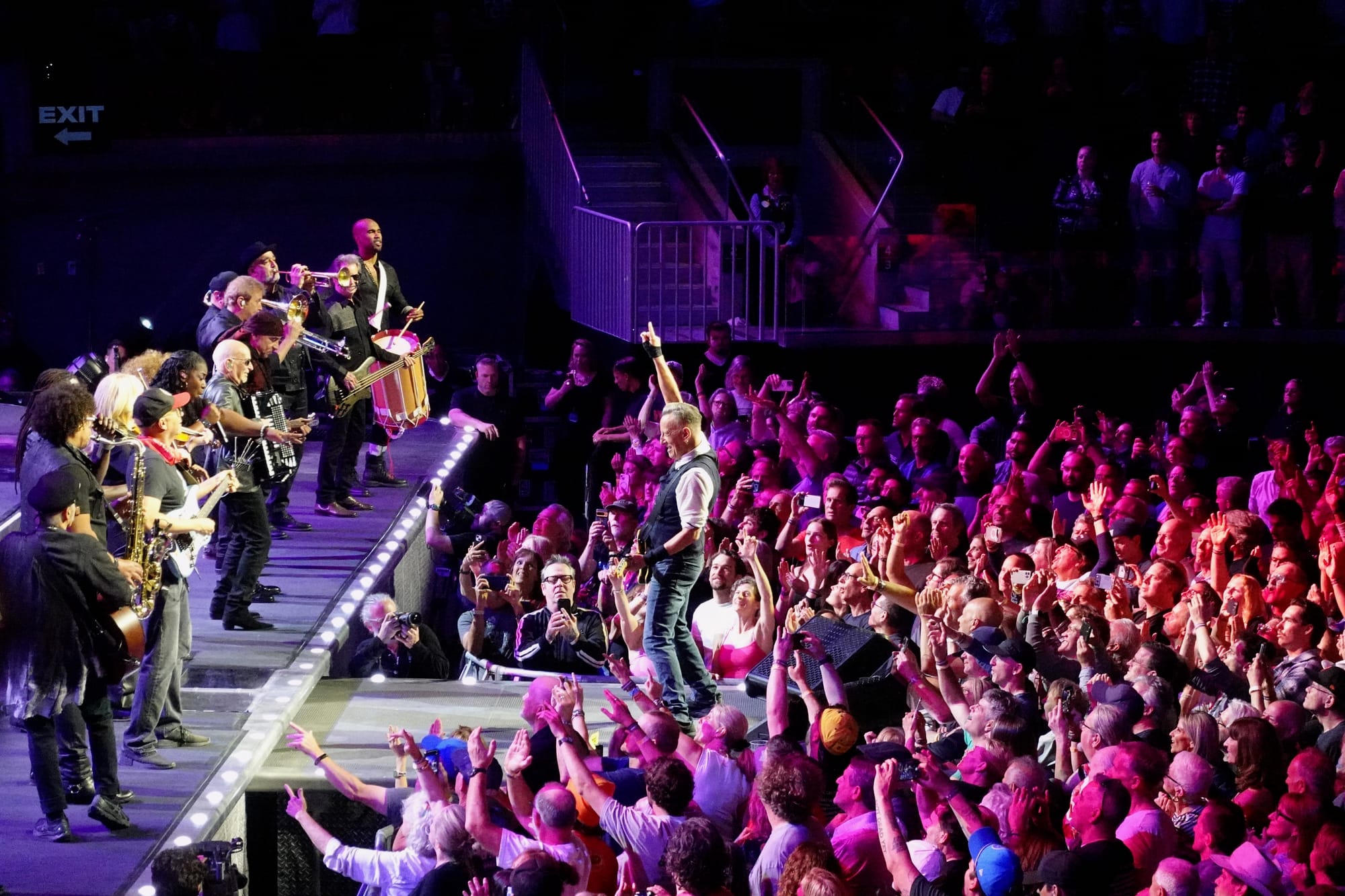
There is no such self-consciousness in the current Land of Hope and Dreams tour. It is a confidently, unapologetically, thoroughly political show. Each night the setlist is substantially the same, dominated by a carefully constructed arc of songs and spoken word-introductions and short (and not-so-short) speeches. I’ve been to quite a few concerts in my life, and I’ve spent the last thirty years working in and around national politics, and what I saw in Spain and Italy last summer and in San Francisco and Phoenix this month may have taken the form of the former, but the content was more deeply and urgently political than the vast majority of political rallies I have seen. The whole show is one sustained public service announcement, with guitar. It is a warning and an attempt to rally the world to stand against authoritarianism. For years, the “shut up and sing” crowd has responded to the briefest of political statements from musicians with sarcastic cracks about going to a concert only for a political rally to break out. Springsteen’s Land of Hope and Dreams tour is the right-wing’s overheated rhetoric come to life, in the best possible way. There is music — great music, performed by supremely talented musicians — but the art is fully in service of a cause.
It’s an almost preposterously ambitious thing to try to pull off a (nearly) three-hour political rally dressed up as a rock concert, but it works. It holds up because it is sturdy. It has roots. Springsteen has been preparing himself and his audience for it for fifty years.
Chimes of Freedom
Every show on the Land of Hope and Dreams (“LOHAD”) tour has closed with Springsteen’s cover of “Chimes of Freedom,”2 the 1964 Bob Dylan song. Chimes of Freedom is a truly great song with lyrics that speak for themselves. But the history of the song and particularly of Springsteen’s use of it gives it an added weight on this tour and places the current struggle against the global rise of fascism in historical context.
Aside from a one-off 1978 performance in Detroit, Bruce Springsteen’s only public performances of “Chimes of Freedom” prior to last year took place in 1988 on the Amnesty International Human Rights Now! tour in celebration of the 40th anniversary of the Declaration of Human Rights3 (and in a few of his own European shows leading up to that tour.) Shortly before the Amnesty tour, Springsteen played Chimes of Freedom behind the iron curtain in East Berlin, introducing it to three hundred thousand East Germans: “I’ve come to play rock and roll for you, in the hope that one day all barriers will be torn down.” On the Amnesty tour he took “Chimes of Freedom” to Buenos Aires just a few years after the fall of a dictatorship that disappeared tens of thousands of Argentinians in secret prisons; to Sao Paulo just months after the restoration of democracy following years of Brazilian dictatorship that censored, tortured, disappeared, and killed dissidents; to New Delhi just four years after organized pogroms killed thousands of Sikhs; and to Zimbabwe in the early days of the Mugabe regime. He was, as he described himself last summer, a musical ambassador of America, but more than that he was an ambassador of freedom.
Bruce Springsteen has generally not lacked for hype at any point in the last 50 years (most of it deserved) but those 1988 shows in Berlin and on the Human Rights Now! tour are among the most under-appreciated things he has done. Books about Springsteen (and there are many) tend to give it at most passing mention. Springsteen himself spent only a few paragraphs on the tour in his 2016 memoir, but those paragraphs make the weight of the performances clear. Of the Zimbabwe show, Springsteen wrote: “The simple mix of a white and black crowd of this size, something that was forbidden and illegal a mere three hundred miles south,4 brought an urgency to our appearance.”
“In South America were countries that had recently experienced the full brunt of dictatorship and the daily trampling of simple human freedoms. Thousands of sons and husbands were disappeared off the streets during the reign of brutal regimes in Argentina and Pinochet’s Chile. Here, Amnesty’s job was immediate, critical and personal. There was something hard to push up against and to feel pushing back. With Pinochet still in power, we played on the border of Chile in Mendoza, Argentina. There the ‘mothers of the disappeared,’ whose loved ones had vanished from their homes and the streets in the years of Pinochet’s dictatorial rule, stood holding placard photos of lost loved ones along the roadside as we drove toward the venue. Their faces were filled with the remnants of terrible things we simply had no clue about or ability to understand back in the USA and proof of the ongoing human will, desire and primal need for justice.”
Springsteen has called “Chimes of Freedom” “one of my favorite songs”5 and “one of the great songs of freedom,”6 but he does not deploy it casually: After those 1988 Human Rights Now! shows, Springsteen didn’t play it again for 37 years, until the beginning of the current Trump administration. There is a heft to the song — to its lyrics, to its history, and to its rarity. Pulling off the shelf a song he previously used to spread a message of hope and freedom to people around the world struggling to free themselves from authoritarian rule, or in the early stages of rebuilding from it, places America’s current struggle alongside some of the 20th century’s most notable struggles for freedom.7
America, Future Tense
Of the tens of thousands of people who saw Bruce Springsteen & The E Street Band in San Sebastián last June, I was probably the only one who thought about Bob Dole while laying awake hours later considering Springsteen’s words.
Dole’s speech accepting the Republican Party’s nomination for president in 1996 was one of the worst speechwriting crimes in the history of American politics, not so much because the text was awful as because it was an awful fit for the speaker. It was a speech written to be read, not spoken — and certainly not spoken by Bob Dole, who stumbled through its lofty rhetoric in his plainspoken and at times halting speaking style. The passage that has always stuck with me had Bob Dole telling the American people “Age has its advantages. Let me be the bridge to an America that only the unknowing call myth. Let me be the bridge to a time of tranquility, faith and confidence in action. ... I know because I was there. And I have seen it. And I remember.” It was a disastrous passage, reinforcing concerns that Dole was a relic of the past and inadvertently handing Bill Clinton’s re-election campaign a perfect contrast to its “Bridge to the 21st Century” theme.
The first time I heard it, something about Springsteen’s statement that “The America that I’ve sung to you about for fifty years is real” reminded me of that Dole passage. There are similarities: Both speakers are old men, nearer the end of their career than the beginning; both are insisting that their vision of America is real and in doing so acknowledging that their audience may be skeptical.
The differences are more interesting.
Dole explicitly set his vision of America in the past, inviting his audience to go back to the country he knew when he was a young man. His vision of America as it should be is America in the 1950s — a time when (as he might not have intended to remind people but many Americans remembered) Black people, women, gays, and pretty much everyone else who wasn’t white, male, and Christian faced explicitly discriminatory laws and hiring practices, segregated schools, whites-only workplaces and lunch counters, and more.
When Bruce Springsteen says “the America that I’ve sung to you about for fifty years is real,” he isn’t talking about a romanticized past version of America, he’s talking about the future, about a version of America we have yet to reach. America as he has sung about it has always been more complicated than white picket fences and two-car garages. As he told European audiences last summer: “I’ve always tried to be a good ambassador for America. I’ve spent my life, my whole life, singing about where we have succeeded, and where we have come up short, in living up to our civic ideals and dreams.”
Springsteen’s line hits different because unlike Dole he isn’t trying to take us back, but to urge us forward.
Talk About a Dream, Try to Make it Real
Campaigning for Barack Obama in 2008, Springsteen explained:
“I’ve spent 35 years writing about America, its people, and the meaning of the American Promise. The Promise that was handed down to us, right here in this city from our founding fathers, with one instruction: Do your best to make these things real. Opportunity, equality, social and economic justice, a fair shake for all of our citizens, the American idea, as a positive influence, around the world for a more just and peaceful existence. These are the things that give our lives hope, shape, and meaning. They are the ties that bind us together and give us faith in our contract with one another.”
Promises and dreams come up often (and often interchangeably) in Springsteen's songs and in his concert introductions to songs — in contexts both hopeful and decidedly less so. At a 1981 show in Stockholm, he introduced his cover of Woody Guthrie’s This Land is Your Land by telling his audience “In America from the time you’re a little kid there’s a promise that gets made, they call it the American Dream, which is just the right to be able to live your life with some decency and some dignity.”8 Three days later in Newcastle, England, he added “it’s a promise that gets broken every day in the most violent way but it’s a promise that never ever, ever fucking dies and it’s always inside you.”
Some of the most haunting passages in Springsteen’s work involve broken promises and unfulfilled dreams, from “When the promise is broken you go on living but it steals something from down in your soul” to “Is a dream a lie if it don’t come true, or is it something worse that sends me down to The River?”
What’s worse than a dream that doesn’t come true? One answer lies in the song’s previous verse:
Now all them things that seemed so important well mister they vanished right into the air. Now I just act like I don’t remember, Mary acts like she don’t care.
“The River” is so devastating not because the narrator’s dreams haven’t come true but because he and his wife seem to have given up on them. It is a song filled with dignity and responsibility, but its lyrics are words of resignation.9
During a concert in Pittsburgh in 1984, Springsteen introduced “The River” with a brief state of the union address:
“There’s something really dangerous happening to us out there. We’re slowly getting split up into two different Americas. Things are gettin’ taken away from people that need them and given to people that don’t need them, and there’s a promise getting broken. In the beginning the idea was that we all live here a little bit like a family, where the strong can help the weak ones, the rich can help the poor ones. I don’t think the American dream was that everybody was going to make it or that everybody was going to make a billion dollars, but it was that everybody was going to have an opportunity and the chance to live a life with some decency and some dignity and a chance for some self-respect.”10
That speech came just a few days after, and clearly in response to, Ronald Reagan’s now-infamous attempt to wrap himself in Springsteen’s “Born in the USA” flag during his re-election campaign.
Born Down In A Dead Man’s Town
I’d love to skip over “Born in the U.S.A.,” about which countless words have been written. But – particularly given its prominence at the beginning of the U.S. Land of Hope and Dreams shows – “Born in the U.S.A.” is essential to thinking about what Bruce Springsteen means when he says “The America that I’ve sung to you about for fifty years is real.”
One reading of Bruce Springsteen’s most famous song treats it as a flag-waving America-is-great anthem with a massive synthesizer riff and driving percussion that all but insist you pump your fist as you shout proudly along with the huge chorus. This George Will/Ronald Reagan America-fuck-yeah interpretation of “Born in the USA” has endured for decades despite being, by a comfortable margin, among the least literate readings of any song in American history.
Another reading, popular among people who have ever paid attention to the lyrics and even more popular among people who like to make fun of those who haven’t,11 is that the song is a searing indictment of a wealthy nation’s abandonment of the citizens it drafted and sent off to fight a war for (at best) questionable reasons. This reading has advantage of being quite obviously correct. But to me it’s incomplete.
A common sentiment among people who recognize the falsity of that Ronald Reagan interpretation of BITUSA is that the song’s sound does it no favors; that instead of releasing it as a drums-and-synth-driven hit single, Springsteen should’ve released the song in its stripped-down acoustic form. The artist disagrees. Writing about BITUSA in Songs, Springsteen explained: “In order to understand the song’s intent, you needed to invest a certain amount of time and effort to absorb both the music and the words. …. Particularly on the Tom Joad tour, I had a[n acoustic] version that could not be misconstrued. But those interpretations always stood in relief to the original and gained some of their new power from the audience’s previous experience with the original version. On the album, ‘Born in the U.S.A.’ was in its most powerful presentation. If I tried to undercut or change the music, I believe I would have had a record that might have been more easily understood, but not as good.”
To me, “Born in the USA” is what in politics we call a “rhetoric-reality document” — a document that debunks a false claim or rhetoric and presents the truth. The music is America’s rhetoric about itself; the lyrics are American reality. The vocals are more shouted than sung because the song’s protagonist has to shout to be heard over the bombastic propaganda and self-delusion of the music. To the extent that the music masks the meaning of the lyrics, that is itself part of the meaning of the song.12
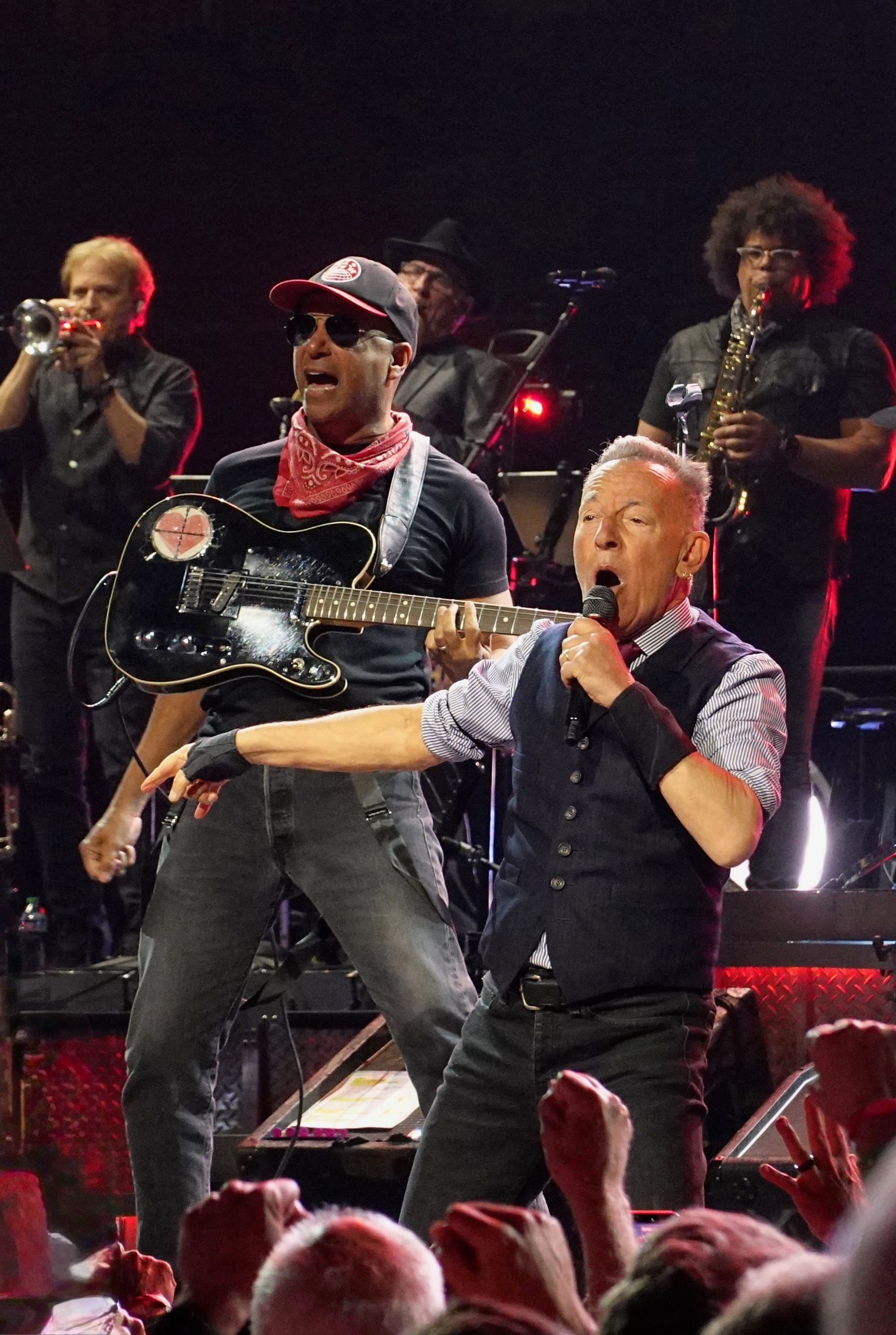
But the music is not there just to be debunked. The music – big, anthemic, demanding fists be pumped – invites us to insist America live up to its self-image. As a stripped-down folk song, those lyrics would tell the truth but they would also bum people out. The best protest songs do not bum people out, they galvanize people to action. They are confident and defiant, not weary. This is why, in my estimation, “The Times They Are A-Changing” (“better start swimming or you’ll sink like a stone”) is superior to “Blowin’ in the Wind.” It is why Bruce Springsteen’s original mid-1990s arrangement of “The Ghost of Tom Joad” is a perfect song but subsequent electric arrangements, particularly those that feature the sonic clenched fist of Tom Morello’s guitar, are better.
In both Songs and Born to Run,13 Springsteen notes that like “Born in the U.S.A.,” Woody Guthrie’s “This Land Is Your Land” was often misinterpreted. It’s a telling comparison. Introducing the Guthrie song in concerts on the Born in the USA tour, Springsteen called it “the greatest song that’s ever been written about America” because “it gets to the heart of the promise of what our country was supposed to be about.”14 Not what our country is or was — what our country was supposed to be. During his 1981 European tour, Springsteen played “This Land is Your Land” regularly. In Berlin, he introduced the song: “Somebody asked me the other night how I could sing this song being that it isn’t true. ... It’s a fighting song, it’s a song that you gotta fight to make it true. It’s a dreaming song, I think it’s one of those dreams that, that just is always in people and it don’t ever die.”
“Born in the USA” is no mindless flag-waving faux patriotism. Nor is it a mere lamentation of America’s shortcomings. Like “This Land is Your Land,” it is a fighting song, one that demands America live up to the ideas it so often falls so short of.
That’s the America Bruce Springsteen has been singing about for 50 years: An America that holds out a promise, but an America in which we still have to fight to make that promise come true.15 That’s the America he was talking about on the 2004 Vote for Change tour when he assured us “the country we carry in our hearts is waiting” — an America that is still waiting for us to build it.
This is “Land of Hope and Dreams”
Springsteen’s Land of Hope and Dreams tour is, of course, named for the song of the same name he first played on his 1999-2000 reunion tour with the E Street Band. “Land of Hope and Dreams” and “Chimes of Freedom” bookended last summer’s European shows,16 driving home the influence the Dylan song likely had on Springsteen’s composition.
Dylan’s “Chimes of Freedom” toll for the rebel, for the rake, for “the luckless and the outcast,” for the “gentle and the kind” and for the “guardians and protectors of the mind.” They toll for “every hung-up person in the whole wide universe.” The train in Springsteen’s “Land of Hope and Dreams” carries saints and sinners, losers and winners. It carries lost souls, and all aboard hear “bells of freedom ringing.” During the final show of The Rising tour in 2003, after Bob Dylan made a surprise guest appearance, Springsteen dedicated “Land of Hope and Dreams” to Dylan, adding “when I wrote this one I was doing my best to follow in his footsteps” — a reference, perhaps, to “Chimes of Freedom.”
Alone among his frequently-played compositions, Springsteen almost always introduces “LOHAD” by name. At this point he has performed it in public nearly 800 times – more often than “The River” or “Bobby Jean,” neither of which need any introduction – yet nearly every time he announces: “This is ‘Land of Hope and Dreams.’” Now, on the tour that bears its name, that phrase makes clear that “LOHAD” – like “Born in the U.S.A.” and Guthrie’s “This Land is Your Land” – is a fighting song. And a statement of purpose: On the closing night of the reunion tour in 2000, Springsteen introduced “Land of Hope and Dreams” by telling his audience “the first night we played [on the reunion tour] we did this song and before we started, I said I was hoping that our tour would be the rebirth and the renewal of our band and of our commitment to serve you.”
“This is ‘Land of Hope and Dreams’” is not a guarantee. It’s a statement of principle, a commitment to serve – and a challenge to the audience to make those dreams reality.17 It resembles the instruction the great writer and singer Patti Smith gives audiences when performing “People Have the Power”: “Make it so!”
Walking Down Dark Alleys
In the days immediately following Donald Trump’s 2024 election, Springsteen introduced one of his greatest songs, “Long Walk Home,” to concert audiences in Canada as a “fighting prayer for my country,” leaving no ambiguity: the song’s key passage is not a boast; it is a promise and a challenge:
My father said “Son, we’re lucky in this town
It’s a beautiful place to be born
It just wraps its arms around you
Nobody crowds you, nobody goes it alone.
You know that flag flying over the courthouse
Means certain things are set in stone
Who we are, what we’ll do and what we won’t.”
Its gonna be a long walk home
Home isn’t a place, it’s an ideal. We’re a long, long way from reaching it, and the ground is rocky. At the beginning of Springsteen’s legendary 1981 benefit concert for Vietnam Veterans of America18 he used a similar going-home metaphor, suggesting we would never get there without more humanity for one another:
“It’s like when you feel, like you’re walking down a dark street at night and out of the corner of your eye you see somebody, you see somebody getting hurt or getting hit in the dark alley but you keep walking on because you think it don’t have nothin’ to do with you and you just want to get home. Well Vietnam turned this whole country into that dark street. And unless we’re able to walk down those dark alleys and look into the eyes of the men and the women that are down there and the things that happened we’re never going to be able to get home.”
Swap out “Vietnam” for “Donald Trump” and that passage would easily fit in the current tour.19 Springsteen’s Land of Hope and Dreams show is unflinching in cataloguing the breadth and depth of the rise of authoritarianism in America and around the world and unwavering in the belief that if we are willing to look and walk down those dark alleys we can help each other come out the other side.
In the 2025 LOHAD shows, immediately after assuring his audience that the America he has been singing about is real, Springsteen added:
“Regardless of its many faults [America] is a great country with a great people, and we will survive this moment. I have hope because I believe in the truth of what the great American writer James Baldwin said. He said ‘In this world there isn’t as much humanity as one would like. But there’s enough.’”
That humanity is all around us, everywhere we look. It’s in the mutual aid networks that sprung up to support communities targeted by ICE raids, the parents of trans kids insisting in the face of a hostile government and news media that their children be treated with dignity, the retired schoolteachers passing out homemade palm cards with lists of things people can do to protect their communities, their neighbors, and their nation. It’s there in the men and women who spend their retirement days leading protests and organizing visibility displays, the whistle-distribution networks. The teacher who turns her knitting hobby into a fundraiser for vulnerable communities, selling sweaters and scarves to help fund legal aid and trans rights organizations. It’s in school children staging walkouts and retirees taking on full time jobs organizing street demonstrations. Everyday Americans, looking down those dark alleys, seeing what out government is doing. And refusing to look away.
Streets of Minneapolis
The current U.S. version of the Land of Hope and Dreams tour features a few changes from the version European audiences saw last summer: A few song changes, in part to take advantage of Tom Morello’s presence at these shows, and some re-worked speeches. The overall narrative is much the same, but with a subtle but important increase in his emphasis on collective action.
As extraordinary as this show is, Springsteen knows a rock concert is not going to destroy American fascism, any more than that show in East Berlin tore down the wall. So Springsteen sends his audiences home understanding it’s up to them.
“When I was fifteen and I heard ‘Like a Rolling Stone,’ I heard a guy who had the guts to take on the whole world and who made me feel like I had to too. Maybe some people misunderstood that voice as saying that somehow Bob was going to do the job for them, but as we grow older, we learn that there isn’t anybody out there who can do that job for anybody else.” – Bruce Springsteen on Bob Dylan, 1988
The heart of the show’s focus on collective action is “Streets of Minneapolis,” the song Springsteen wrote earlier this year after the government killings of Renee Good and Alex Pretti. The first thing that struck me about “Streets of Minneapolis” when Springsteen unveiled it in January was the callback to “Streets of Philadelphia,” his song for the 1993 Jonathan Demme film about a man dying of AIDS. In the earlier song, Springsteen’s narrator wonders “will we leave each other alone like this on the streets of Philadelphia?” Streets of Minneapolis offers an answer: We will not. We will stand together: “We’ll take our stand for this land and the stranger in our midst / We’ll remember the names of those who died on the streets of Minneapolis.”
Introducing “Streets of Minneapolis” on the Land of Hope and Dreams tour, Springsteen celebrates “the power and solidarity of the people of Minnesota”:
“We want to send a shout out to all you Los Angeles activists and peaceful protesters from last year.20 This past winter federal troops brought death and terror to the streets of Minneapolis. But they picked the wrong town. The power and solidarity of the people of Minnesota was an inspiration to the entire country. Their strength and their commitment told us that this is still America, and this will not stand. They gave us hope. They gave us courage. And for those who gave their lives, Renee Good, mother of three, brutally murdered; Alex Pretti, VA nurse, executed by ICE, shot in the back and left to die in the street, without even the decency of our lawless government investigating their deaths. Their bravery, their sacrifice, and their names will not be forgotten.”
A few minutes later, in the middle of “Streets of Minnesota,” the E Street Band drops out, leaving Springsteen alone plucking at his guitar as he leads the crowd in repeated shouts of “ICE OUT NOW.” It’s a powerful moment, hearing 15,000 or so of your neighbors yell that in unison. It’s also a savvy bit of organizing and empowering, turning concert attendees into participants, connecting them with the Minnesota activists Springsteen has just celebrated as an inspiration.
Two hours later, introducing the show-ending “Chimes of Freedom,” Springsteen makes a closing case that we’re in this together: “These are hard times, and the E Street Band was built for hard times. Hard times, but we’ll make it through. We’ll make it through. Because we’re the Americans.” And then, after again invoking Renee Good:
“Find a way to take aggressive, peaceful action to defend our country’s ideals. And as the great civil rights leader John Lewis said, go out and get in some good trouble. Say something. Do something. Hell, sing something. That’s all that I do. If you’re feeling helpless, hopeless, betrayed, frustrated, angry: I understand. I have felt that way too. … That’s why the E Street Band is here tonight. Because we needed to feel your strength and your hope. And we needed to bring you some strength and some hope in these times. I hope we’ve done that for you tonight. God bless Alex Pretti. God bless Renee Good. God bless you. And God bless America.”21
After “Chimes,” Springsteen sends the audience home with a final instruction, referencing one of his greatest songs: “Stay hard, stay hungry, stay alive, stay strong, and stay hopeful.”
Thanks for reading. Subscribing to this newsletter is free, but producing and publishing it is not. If you’d like to support my work, please consider a paid subscription.
Footnotes
1 Speaking of “collage,” I will note up front that throughout I deploy some Springsteen lyrics and statements in contexts and ways that do not always align with their most straightforward original meanings or interpretations. Please do not feel obligated to tell me “that isn’t what that song is about.” Also, I wrote most of this prior to seeing two shows in the U.S. iteration of the Land of Hope and Dreams tour currently underway, so it is based primarily on last summer’s European shows. The changes in this year’s shows — a handful of songs and some differences in Springsteen’s speeches — are not insignificant, but the shows are similar in structure, in message, and in spirit.
2 Except the second night in Milan, where those of us present for the final night of the European tour were treated to a bonus cover of John Fogerty’s “Rockin’ All Over the World” after “Chimes.”
3 The other artists on the Human Rights Now! tour were Sting, Peter Gabriel, Youssou N'Dour, and Tracy Chapman.
4 In South Africa, where Nelson Mandela was still in prison and Apartheid was still in effect.
5 Detroit September 1, 1978
6 Milan, July 3, 2025
7 Based on my observations in San Francisco and Phoenix this month, and even in Europe last summer, “Chimes of Freedom” is far from universally recognized. But from what I’ve seen, crowds have been quite attentive to it anyway. Such is the power of the lyrics and the moment. If you’re planning on seeing a Land of Hope and Dreams show and aren’t familiar with “Chimes” I’d strongly recommend checking it out before you go. Springsteen omits a few of Dylan’s verses (it’s a very long song) so you might want to focus on the version released digitally last year. Give it a couple listens and I bet that when you see it in person you’ll find your arm thrust in the air at a few key lines.
8 Stockholm, Sweden, May 8, 1981. Throughout this piece when quoting Springsteen’s spoken remarks at concerts I have very lightly cleaned them up for readability – removing a few uhs and I guesses here and there, along with some repetition that is a consequence of speaking to, and through the applause of, a live audience. Some of those remarks I have transcribed myself; for others I have relied upon the “Brucebase” website.
9 “The River” might be the most unlikely mass singalong song in all of rock history. Tens of thousands of people in a European football stadium singing lines like “for my nineteenth birthday I got a union card and a wedding coat” and “lately there ain’t been much work on account of the economy” is something you have to see to believe. It’s extraordinary.
10 Dave Marsh, Bruce Springsteen: Two Hearts
11 Guilty!
12 This interpretation is not canon. I’m pretty sure I’ve never seen Bruce Springsteen describe it this way, and mildly sure I’ve never seen anyone else describe it quite this way.
13 The book, not the song or the album.
14 Chicago, August 9, 1985
15 “Keep pushing ’til it’s understood and these badlands start treating us good”
16 “Land of Hope and Dreams” was sometimes the first song of the evening; sometimes it was preceded by one or two songs. Either way, it formally introduced the show’s narrative arc. “Chimes,” as I have mentioned, closed out that arc each night. For this year’s U.S. shows, “LOHAD” comes later in the evening, with “Born in the USA” moving up to the beginning.
17 After all, as Springsteen told a Los Angeles audience in 1981: “Dreams don’t mean nothin’ unless you’re strong enough to fight for them and make them come true.”
18 On August 20, 1981 Bruce Springsteen played a concert in Los Angeles as a benefit for the organization Vietnam Veterans of America, which was deeply in debt and struggling to survive. VVA cofounder Bobby Muller later said that without that show and Springsteen’s continued efforts “there would not have been a coherent, national movement on behalf of Vietnam vets.”
19 Though – as with the Vietnam war – Donald Trump didn’t invent America’s flaws; he amplified them.
20 These comments are transcribed from the April 9, 2026 Los Angeles show.
21 These comments are transcribed from the April 9, 2026 Los Angeles show.
Member discussion