The New York Times invents a Democratic scandal while ignoring a new Trump rape allegation
America is four days out from the end of an election in which America’s deeply unpopular fascist ruling party is trying to retain control of Congress. The week began with yet another new rape allegation against the president of the united states, a man who has already been found liable for sexual assault in another case. The president and his allies are frantically whipping up hatred and anger at racial minorities in a continuation of a decade-long effort to inspire and incite violence against those who oppose them. They continue to disappear people off of American streets without trial, wage a figurative war against free expression and a literal war that has driven up prices for American families, all while plundering the treasury for their own financial gain.
Against that backdrop, the national news media is doing everything they can to make the central story of the last days of this election season an alleged political maneuver by Alaska Democrats that was, by all accounts, legal, consistent with past behavior by both major political parties, and unlikely to have any real effect on the outcome of the Alaska Senate race. America’s dominant news companies, led by the New York Times, have literally ignored the new rape allegation against the president of the United States while breathlessly hyping the Alaska maneuver, giving Donald Trump the distraction he desperately seeks and a phony premise for his anti-democratic efforts to effectively cancel a Senate election that could determine control of the entire U.S. Senate. It is, in the most charitable assessment, a gross and feckless abandonment of the news media’s responsibility to provide voters the information they need to make considered decisions about the future of their country.
Here’s the Alaska situation: The New York Times reported allegations that people associated with the campaign of Democratic Senate nominee Mary Peltola recruited an Alaskan named Dan Sullivan to run for the Senate in order to siphon votes away from incumbent Republican Senator Dan Sullivan.
This no doubt strikes some people as unsportsmanlike, but it is important to understand a few things:
1) It is legal.
2) There is ample precedent for this precise maneuver, as well as countless others that are merely similar, from both political parties, both this election season and historically.
3) This particular maneuver is exceedingly unlikely to have an effect on the outcome of the Alaska senate race, because Alaska uses ranked-choice voting, which means that any Alaskan who wants to vote for the Republican incumbent Senator Dan Sullivan but who is somehow confused about which Dan Sullivan he is on the ballot despite the fact that only one Dan Sullivan on the ballot is identified with the words “Republican” or “incumbent” can simply rank the two Dan Sullivans as first and second choices in either order and that vote will ultimately be counted for the Republican incumbent Senator Dan Sullivan.

All of that adds up to something that simply does not matter. It is not an important thing whether some operatives associated with Mary Peltola’s campaign made themselves feel savvy and sneaky with an utterly pointless maneuver that won’t prevent anyone who wants to vote for the Republican incumbent Senator Dan Sullivan from successfully doing so. “Legal, common, bipartisan, and ineffectual” is not the stuff of scandal. There is absolutely no reason anyone should be thinking, talking, writing, or reporting about any of this in the final days of an election in which fascism is very literally on the ballot nationwide. I am very angry to be wasting my time to be spending any of my time on this at all, and I am angry on your behalf that it is being inflicted on you.
At this writing, the New York Times has now run more than a dozen reports on this matter in just three days. The Times is in the kind of full-court press mode it saves for things like Joe Biden stumbling over his words. By my tally, the alleged Peltola maneuver has been a primary subject of six New York Times articles, four New York Times newsletters, a New York Times podcast, a New York Times video, and two letters to the editor the New York Times chose to run. At least nine New York Times journalists have bylines on these pieces. I can only imagine what the Sunday crossword puzzle has in store for us.1
Meanwhile, the New York Times still has not told readers of a new rape allegation against Donald Trump that was made public on Monday in a report the New York Times dishonestly dismissed on grounds that “it largely cites allegations that have already been public.” The word “largely” is doing a awful lot of work in that sentence, given that the report includes a new rape allegation.
The New York Times’ desperation to find a Democratic scandal isn’t confined to Alaska: This morning’s “editor’s picks” email from the Times hyped an article the paper published yesterday dredging up Republican claims that Minnesota Rep. Ilhan Omar married her brother, which Rep. Omar has long denied:
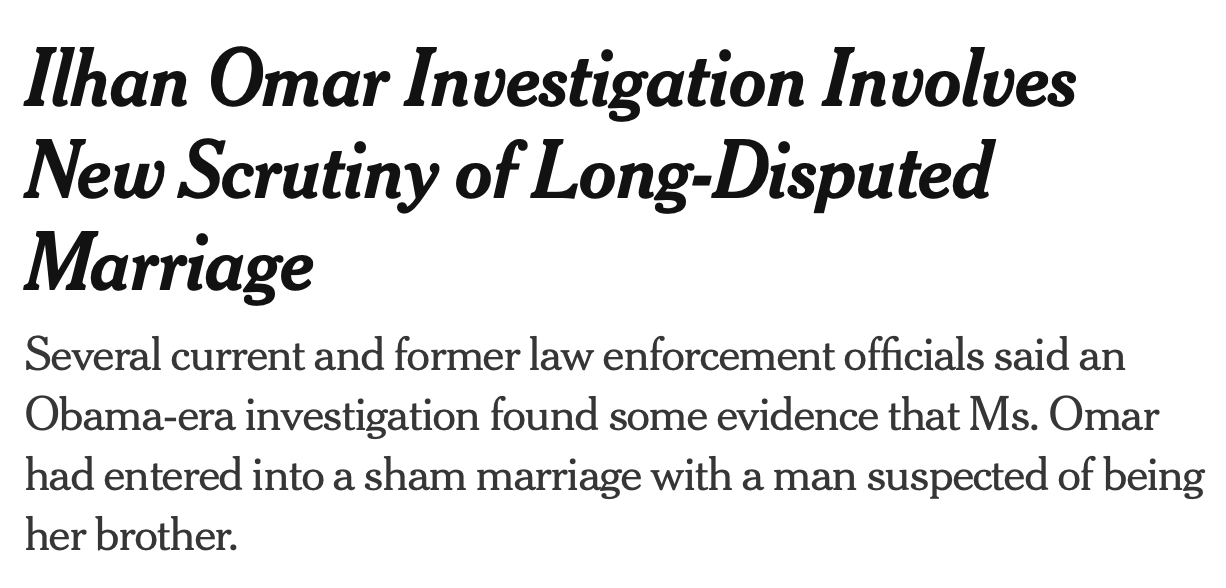
In paragraph seven, the Times article acknowledges “It is unclear what evidence prosecutors, then or now, have showing that the person Ms. Omar married was her brother.”
So, without having any idea at all what evidence anyone has, the New York Times has decided to play into the Trump regime’s vicious, racist attacks on Somali-Americans.
These are, at best, deeply unserious people.2
Predictably, a bunch of journalists have leapt to defend the New York Times’ coverage of the Alaska allegations. But these defenses fall short because they assess the initial Times story in a vacuum, as though the key question is whether the story in and of itself is newsworthy. But the “worthy” part of newsworthy is load-bearing, and it requires us to weigh a story’s merit against the merit of other stories that are not reported, or that are reported but that are not hyped as much. It requires us to assess a story outside a vacuum, in comparison to other things.
The Times’ initial article wasn’t inherently un-newsworthy, but in comparison to things the Times hasn’t covered at all (a new rape allegation against the current president of the United States, for example) a legal, precedented, bipartisan, inconsequential ploy dismissed by even those who defend the decision to cover it as a “tempest in a teapot” ... well, suddenly its newsworthiness suddenly doesn’t look so great, does it. And weighed against the question “Is this worthy of a central position in media coverage of the final week of an election in which a deeply unpopular, virulently racist and fascist regime seeks to cling to power” it falls far short.
This is a common defense mode for journalists defending coverage that faces scrutiny and criticism; I’ve been banging my head against this particular wall for a quarter century. “It’s true” and “it’s newsworthy” are not adequate reasons to publish something without grappling with the all-important question: compared to what? In a vacuum, compared to nothing, sure, allegations that the Perlota campaign did something that is legal, that has been done before by both parties, and that will have no effect on the Alaska Senate race due to the mechanics of ranked choice voting are a little bit newsworthy. Kinda. But in context -- in America, in October of 2026, compared to a rape allegation against the president? That’s a much tougher sell.
And this was never going to be one article. As soon as I saw the Times’ first story on this topic, the one so many people have rushed to defend, I knew the paper was going full-court press with this one. It was obvious in the length and wording of the article itself, in the “exclusive” tag the Times affixed to it, and based on my decades of experience observing the New York Times. A dozen pieces in three days, spanning text, video, and audio formats – that was extremely predictable to close observers of the Times and of the news media. And that level of hype – that decision to make this exceedingly minor story one of the dominant media storylines of the last week of the election – is entirely indefensible.
In 2024 I concluded my lengthy rebuttal to New York Times executive editor Joe Kahn’s defense of the paper with this passage:
The news media should tell its audience true things, in proportion to their importance, with no concern for how anyone feels about it. That’s what democracy requires of journalists. And that’s what it means to practice independent journalism, “without fear or favor.”
In proportion to their importance is the key. That’s the big thing the big news companies fail at most often.
The news media’s role in a democracy is to provide voters the information they need to make well-considered decisions about the most important matters facing the nation. In the final few weeks of the campaign, when voters are paying closest attention (and when many are paying attention for the first time) is a time for a focus on the big picture; for summational coverage that centers the most important things. It is not a time to center trivial things that happen to occur late in the campaign, or that the news media happens to find out about late in the campaign. To do so is to abdicate the essential role the news media plays in democracy.
Thanks for reading. Subscribing to this newsletter is free, but producing and publishing it is not. If you’d like to support my work, please consider a paid subscription.
1 Here they are:
“Democratic Senate Candidate Denies Knowledge of Alaska Ballot Stacking,” By Axel Boada, 10/30/26 (video)
“Democratic Candidate Mary Peltola Says She Didn’t Know About Alaska Ballot Stacking,” By Isabella Kwai, 10/30/26
“Republicans Ramp Up Investigation Into Democratic Plan to Pack Alaska’s Ballot,” Kellen Browning Anna Griffin and Glenn Thrush, 10/29/26
“Ballot Stacking in Elections? History Shows It’s Not Unusual.”
By Madison Malone Kircher, 10/29/26
“Fallout in the Last Frontier / Both sides have a long tradition of promoting spoiler candidates.” By Jess Bidgood, 10/29/26 (On Politics newsletter)
“A Tale of Alaska, Peltola and the Two Dan Sullivans,” 10/29/26 (Two letters to the editor)
“Third-Party Spoilers, Long Fueled by Both Parties, Could Matter This Year,”
By Reid J. Epstein, 10/29/26
“Stacking Ballots,” By Sam Sifton, 10/29/26 (The Morning newsletter)
“A Plan for Two Dans: How Democrats Manipulated Alaska’s Ballot,” 10/29/26 (The Daily podcast)
“Alaska Governor Orders Criminal Investigation Into Peltola Campaign,”
By Kellen Browning and Anna Griffin, 10/28/26
“He Predates Trump. Will He Be There After? Plus, ballot-stacking in Alaska and a polling surprise in South Carolina.,” By Jess Bidgood, 10/28/26 (On Politics newsletter)
“A Ballot-Stacking Effort in Alaska,” By Matthew Cullen, 10/28/26 (The Evening newsletter)
“Inside Democrats’ Secret Effort to Stack Alaska’s Ballot,” By Kellen Browning, 10/28/26
2 This, of course, is not limited to the New York Times. The Times remains the most influential news company in the world, and when the Times hypes a story the way it is hyping the Alaska nonsense, the rest of the media joins in. From NPR to Fox News, they’ve helped the Times make a legal, precedented, bipartisan, and ineffectual campaign tactic allegedly deployed by Democrats in Alaska the biggest political story of the week before election day. Of course Fox can’t help bullshitting its audience about not only the underlying facts, but about media coverage as well: It ran a piece complaining “Liberal media downplays Alaska ballot scandal while decrying GOP ‘pouncing’” that consisted entirely of examples of the news media hyping the scandal.
Member discussion