The New York Times manufactures consent for ICE
Most Americans disapprove of the Trump regime’s lawless terrorizing of American cities under the guise of immigration enforcement, but you wouldn’t know that from reading two recent New York Times articles that center the views of Republicans rather than all Americans and falsely suggest reform proposals are unpopular.
Here’s the Times today:
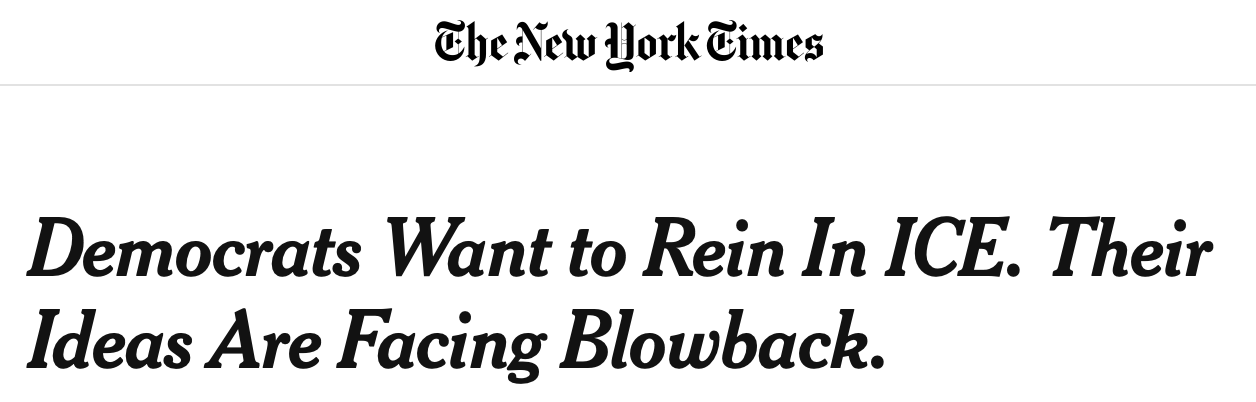
The “blowback” detailed in the article consists of criticism from Republican Speaker of the House Mike Johnson and a few experts saying things like “it’s going to be incredibly difficult [for Democrats] to rein in the things that bother them without winning the White House.”
This is simply not what “blowback” means, and it is wildly misleading to run an article hyping “blowback” to ICE reform proposals based on such thin grounds. As G. Elliott Morris has demonstrated, ICE reforms enjoy the overwhelming support of the American people:
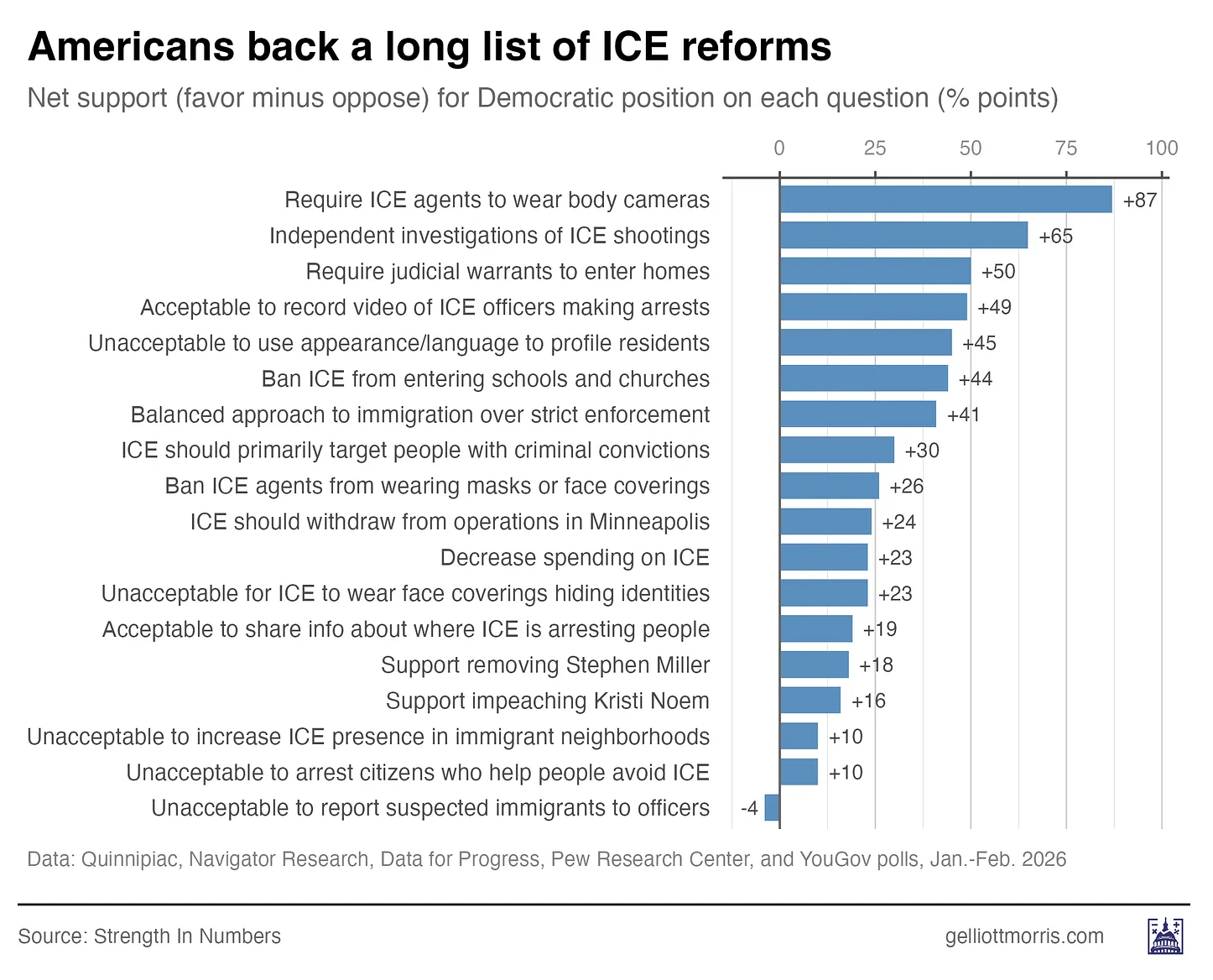
Morris concludes:
Recent events have put Democrats in a very strong position to demand serious reforms of immigration enforcement. In the polls I collected for this article, reformers emerge with a clear lead on 14/15 key questions, and are tied with Republicans on the 15th (whether it is acceptable to report to authorities you are suspicions that someone is living in America without authorization.)
Today’s New York Times article claiming reform proposals are facing “blowback” carefully omits any of this data, and includes only one brief reference to public opinion:
Polls show that while many Americans say they support President Trump on immigration, a growing number believe his administration’s enforcement tactics have become too aggressive.
That phrasing – leading with support for Trump on immigration and treating belief that his tactics are too aggressive as a subordinate position, while omitting any actual numbers – completely distorts the reality of public opinion. Belief that the administrations tactics are too aggressive is not merely “growing,” it is the majority position in America, by a large margin.
The previous New York Times article that passage links to is even worse. Just take a look at the headline:
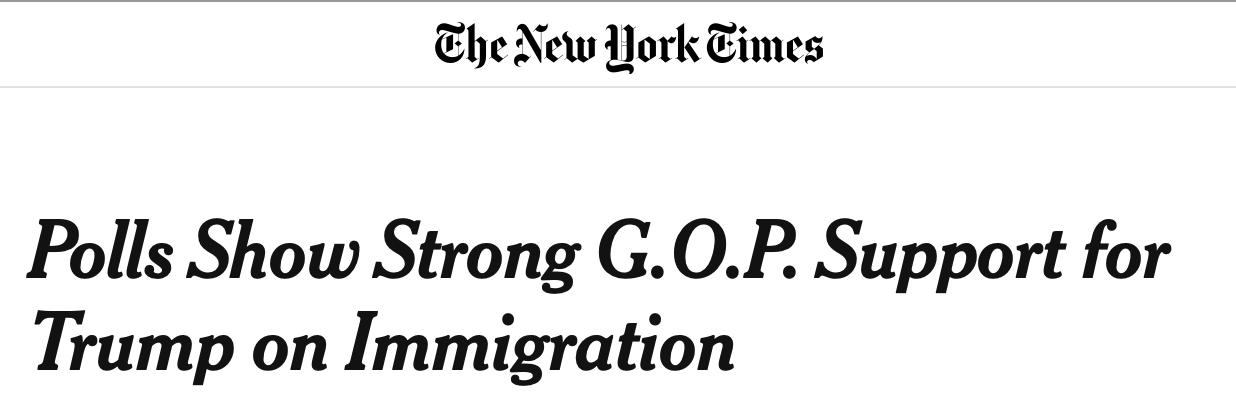
And the lede:
New polls show that a vast majority of Republicans still support President Trump’s aggressive immigration enforcement, which led to the killing of two protesters in Minneapolis last month.
But the polls, one by the public affairs firm Ipsos, another from Pew Research Center, also reveal that a small, but growing, share of Republicans now say that the Trump administration’s enforcement tactics have gone too far. And independent voters, who helped swing the 2024 election to Mr. Trump, also say that enforcement has gotten out of hand.
The two polls in question show large majorities of the American people disapprove of the Trump regime’s actions. But by centering “strong G.O.P. support for Trump on Immigration” (headline) and the “vast majority of Republicans,” while making only a single passing reference to the views of Americans as a whole, the Times obscures the breadth of opposition to Trump and suggests he is on firm ground.
Here’s what the Ipsos poll found:
- “A majority of Americans say current efforts by ICE officers to deal with unauthorized immigration go too far (62%), compared to 13% who say current efforts do not go far enough and 23% who say current efforts are about right.”
- Americans are far more likely to say it is important to have “training and conduct standards for federal officers who enforce immigration laws” (80% of Americans) than to “secure borders to prevent people from entering the U.S. illegally” (61 percent of Americans).
- 60 percent of Americans favor “a way for undocumented immigrants in the country to gain legal status if they have jobs and no criminal record,” essentially the as support for “secure borders.”
- Only 16 percent of Americans say the killing of Alex Pretti was a necessary use of force.
And here’s what the Pew poll found:
- Only 37 percent of Americans approve of the way Donald Trump is handling his job as president, while 61 percent disapprove (49 percent very strongly disapprove.”
- A majority of Americans are not confident Trump “has the mental fitness needed to do the job” while only 32 percent are very or somewhat confident he does and only 27 percent are very or somewhat confident he has the necessary physical fitness.
- 58 percent are not confident Trump “respects the country’s democratic values” while only 25 percent say they are very or somewhat confident he does.
- 60 percent are not confident Trump acts ethically in office; only 21 percent are very or somewhat confident he does.
- 80 percent of Americans oppose “giving people priority in the immigration process if they pay a $1 million fee.” (Trump is selling immigration status.)
- 66 percent of Americans oppose “Suspending all asylum applications from people seeking to live in the U.S. to escape violence or danger.” (Trump has done just that, saying “We don’t want those people.”)
- 64 percent of Americans oppose “Keeping large numbers of immigrants in detention centers while their cases are decided.” (The Trump regime is keeping people in concentration camps with worm-ridden food and overflowing sewage for months on end before they even see a judge.)
- 61 percent of Americans think it is unacceptable for immigration officials to “wear face coverings that hide their identities while working.” (You already know.)
- 71 percent of Americans think it is unacceptable for immigration officials to “use a person’s looks or the language they speak as a reason to check their immigration status.” (Trump henchman Tom Homan has said ICE can detain people based on their physical appearance, and the Trump-allied Supreme Court has allowed ICE to use racial profiling.)
The New York Times saw those two polls and decided the key thing it wanted its readers to know was “Polls Shows Strong G.O.P. Support for Trump on Immigration.”
I’m sure knee-jerk Times defenders will reject this critique, arguing (tautologically) that the Times article wasn’t about public opinion broadly but rather about Trump’s support among Republicans. But that’s exactly the problem. Centering Republicans in this way, while making only passing mention of the disapproval of the public at large, treats Republicans as the only people who matters. It obscures the broad opposition to the Trump regime, and thus props it up.
There are sometimes sound reasons for a news report to focus on a president’s support among his own party, but the way the Times did so in this case is deeply flawed, both because it failed to make clear the scale of the disconnect between Republican Trump supporters and the country as a whole, and because it downplayed the erosion of support for Trump among Republicans, which it portrays as “modest.” In fact, the Ipsos poll found that in just one week the percent of Republicans saying ICE goes too far leapt from 20% to 30%. That ten percentage point increase represents a 50 percent increase in the number of Republicans saying ICE goes too far, in just a week.
Assessing Trump’s support among Republicans can be a journalistically valid approach – if you make clear how sharply that support diverges from the public at large, and emphasize rather than downplaying the extent of the erosion of Republican support for Trump. Such an article would illuminate Trump’s political weakness, demonstrate the peril for congressional Republicans in standing by him, and make clear the public’s rejection of the lawless and immoral terrorization of American cities Trump has unleashed. The New York Times instead chose to obscure those realities in favor of manufacturing consent for the Trump regime.
Previously:
- Donald Trump's attacks on immigrants are unpopular. Here's how pundits got it wrong.
- Trump’s military occupation of American cities is unpopular. The media is trying to manufacture consent for it.
- Trump declares war on an American city. The news media tries to manufactures consent – but it isn’t working.
Thanks for reading. Subscribing to this newsletter is free, but producing and publishing it is not. If you’d like to support my work, please consider a paid subscription.
Member discussion