The New York Times offers a dishonest defense of its efforts to invent a Democratic scandal
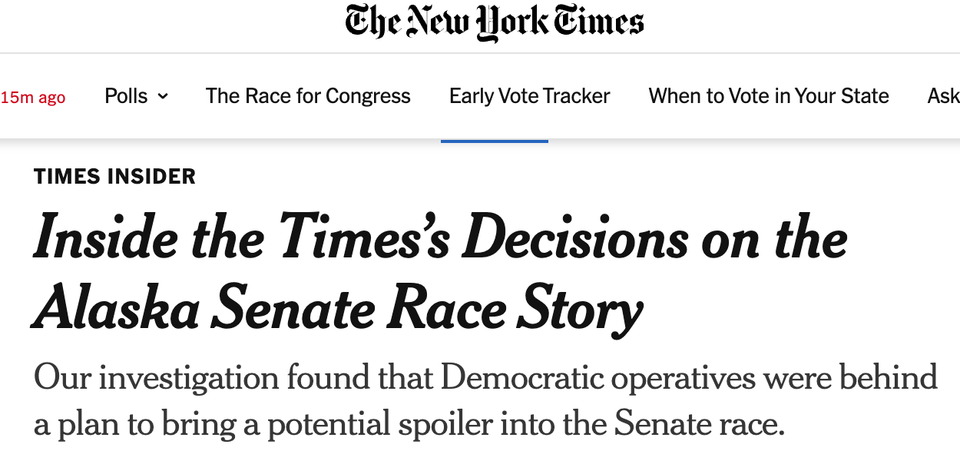
A New York Times editor and reporter have offered a deeply disingenuous defense of the newspaper’s wall-to-wall efforts to invent a Democratic scandal in the Alaska Senate race, even as the paper has published yet another deeply misleading article about the matter.
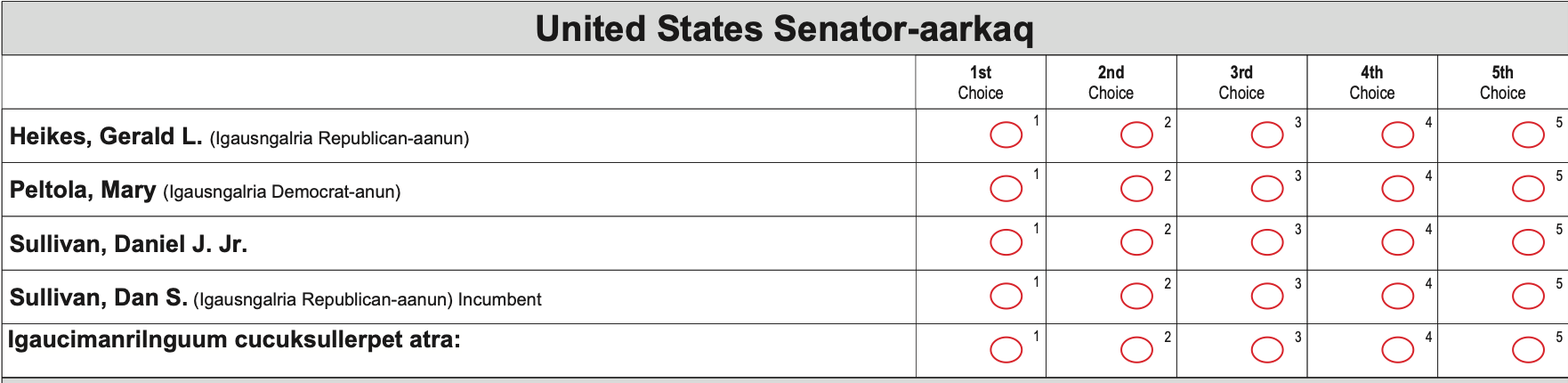
On Friday, I published a lengthy critique of the New York Times’ coverage of the Dans Sullivan in Alaska – coverage that, at the time, consisted of a dozen print, audio, video, and newsletter dispatches in just three days, all for a maneuver that by the New York Times’ own admissions breaks no laws and has ample precedent in similar maneuvers by both political parties. A maneuver that was exceedingly pointless and ineffectual, because Alaska’s use of ranked-choice voting means that a voter who is somehow uncertain whether the Dan Sullivan identified on the ballot as the Republican incumbent Dan Sullivan can simply rank the two Dan Sullivans 1-2. I went into all of this and more in greater detail in the piece I published on Friday.
Now the New York Times has defended its coverage of the Alaska nontroversy in a lengthy Q&A discussion between three of its journalists: Patrick Healy, assistant managing editor for Standards and Trust,1 political reporter Kellen Browning, and deputy politics editor Amy Gardner.
It is not a compelling defense.
Readers have asked us about the timing of our investigation into the Democrats’ plan to stack the Alaska ballot — specifically, why we published it so close to Election Day. Some readers have accused The Times of manufacturing an “October Surprise” to influence the race. Why did we publish this article when we did?
AMY GARDNER: I’d say a couple of things here. First, we published the story as soon as we had it nailed down. It was a complicated story. Our reporting began in earnest in September, after Kellen’s piece published on Peltola’s management style. It took Kellen and other New York Times journalists weeks to run down every new lead and confirm the important facts with multiple sources.
And second, once the story was nailed down, not publishing would have been a more overt act of putting our finger on the scale of this election. Publishing what we knew, and letting readers decide how they felt about it all, was the only ethical option.
“Not publishing would have been a more overt act of putting our finger on the scale of this election” is nonsense. The decision to publish is a decision; the decision not to publish is a decision. It is disingenuous at best for a New York Times editor to pretend that publishing is a default state and not publishing is an active decision. Gardner’s defense is a clear case of begging the question: Not publishing is only “putting our finger on the scale” if the matter is worthy of the prominence the Times gave it, and more worthy than other matters the Times covered less prominently or not at all. Like, for example, the new rape allegation against Donald Trump that the Times chose not to report last week.2 Gardner doesn’t bother to argue that the Dans Sullivan story is actually one of the most important matters to cover in the last few days of an election; she breezes past that in hopes that the reader won’t notice and simply asserts that not publishing would have been putting a finger on the scale.3
Gardner’s next line is even worse: “Publishing what we knew, and letting readers decide how they felt about it all, was the only ethical option.”
This is pure, unadulterated bullshit. The New York Times knows a lot of things it doesn’t “publish and let readers decide how they feel.” Publishing a newspaper involves a ton of judgements. Every day, every hour, the New York Times makes decisions about which of the things it knows it will publish and “let readers decide how they feel about” and which of the things it knows it will not publish and not “let readers decide how they feel about.” Those judgements are among the most important judgements journalists make: They have greater power to affect what people think about than what people think. This agenda-setting power is perhaps their greatest power, and Gardner is pretending it doesn’t exist – pretending that the “only ethical option” is to publish and “let readers decide.” But if that’s really the only ethical option, the New York Times behaves unethically every day, every time it chooses not to publish something it knows. Such as, again, the existence of a new rape allegation agains the current president of the United States. Finally, I can’t help noting that “We report, you decide” is a marketing slogan famously deployed by the infamously biased Fox News.
Browning then reiterated Gardner’s disingenuous response:
Kellen [Browning]: I was hustling to report out this story. We wanted to publish as soon as possible, but more important was making sure we verified every fact we were including. That takes time. My view is we should put the facts out there and let readers decide whether they are significant to them. Some voters in Alaska may decide this should impact their vote, and others may say it doesn’t matter to them. As a reporter, I don’t have a side in this race — I just want people to be informed about what’s happening in it.
“We should put the facts out there and let readers decide whether they are significant” is the kind of things journalists say all the time in hopes that it will sound neutral and judgement-free, but it rests on the assumption that we are too stupid to understand that the decision about which facts they “put out there” and which they do not is itself a judgement. With his conclusion that “I just want people to be informed about what’s happening,” Kellen again breezes past the central critique of the Times coverage of this story: Is this really the most important thing for people to be informed about?
Next:
Ballot-stacking is generally considered legal. Republicans have used the tactic in Alaska. What was newsworthy about the effort that led us to write an article?
Amy Gardner: It’s not unprecedented for campaigns or major parties to find decoy candidates with the same name as a major-party contender. But it is rare, and that’s what made the candidacy of Dan J. Sullivan unusual. We’ve also written extensively about other ballot-stacking efforts, by both parties — including in Alaska this year. Dan J. Sullivan’s candidacy also became a subject of interest in the Alaska political world and beyond, and questions were being raised when he barely campaigned. There is also the fact that the Peltola campaign so vigorously denied it, for so long. That made it a bigger story, in the end.
So here a New York Times editor admits that both parties engage in “ballot-stacking efforts.” Why then does the Times give this alleged effort wall-to-wall coverage in the last days of the election? Neither Healy nor Gardner nor Kellen ever defends or even acknowledges the scale of the Times’ coverage – again, a central critique of the paper’s handling of the matter. The Times pushed this, hard, as perhaps the biggest political story in the entire nation, in the final days of the election. The fact that nobody involved in this discussion was willing to acknowledge that, much less defend it, is a pretty clear indication that they know it is indefensible.
Another tell: Gardner’s use of the passive voice: “questions were being raised.” By who? Republicans. Gardner seemed to understand that saying “we treated this story like Her Emails because Republicans were raising questions” wouldn’t go over well, so she hides behind the passive voice.
The three then go on for some time about the mechanics of reporting the story – who they interviewed and whatnot, all of which seems largely a distraction from the central criticism with which they refuse to engage: They treated this story like a massive scandal when it clearly is not. Then the conversation concludes:
President Trump and Republicans have cited The Times’s reporting in their calls for any Peltola victory to be nullified. Does the potential post-publication impact of our reporting ever influence decisions we make about publishing?
Amy Gardner: It doesn’t, at least as far as politics. The calculation may be different when editors are talking with, say, intelligence officials over whether reporting would threaten national security, or endanger the lives of Americans. But on a story that provides more information to voters about a candidate for Senate? I’m much more comfortable letting readers assess and judge for themselves rather than deciding for them that they shouldn’t see it.
It simply is not true that “the potential post-publication impact of our reporting” doesn’t ever influence decisions about political coverage. We know this because Gardner have just repeatedly said they thought voters should have this information and “decide for themselves.” They obviously intended their coverage to have an impact. You don’t make a point of saying it is important to give voters the information if you don’t think it will have an impact.
Perhaps Gardner means they don’t consider the direction of impact. That doesn’t pass the laugh test given how hard the Times has pushed this as a Democratic scandal. It also crashes against the reality that the Times has repeatedly downplayed inconvenient facts: The fact that the maneuver apparently broke no laws, that it has ample precedent in both parties, and that Alaska’s ranked-choice ballot means that the maneuver will have at most a negligible impact on the results.
To that last point: As I write this, the New York Times is currently pushing yet another article on the matter, right near the top of its website, continuing its treatment of the Alaska ballot maneuver as a seismic political scandal of paramount importance:
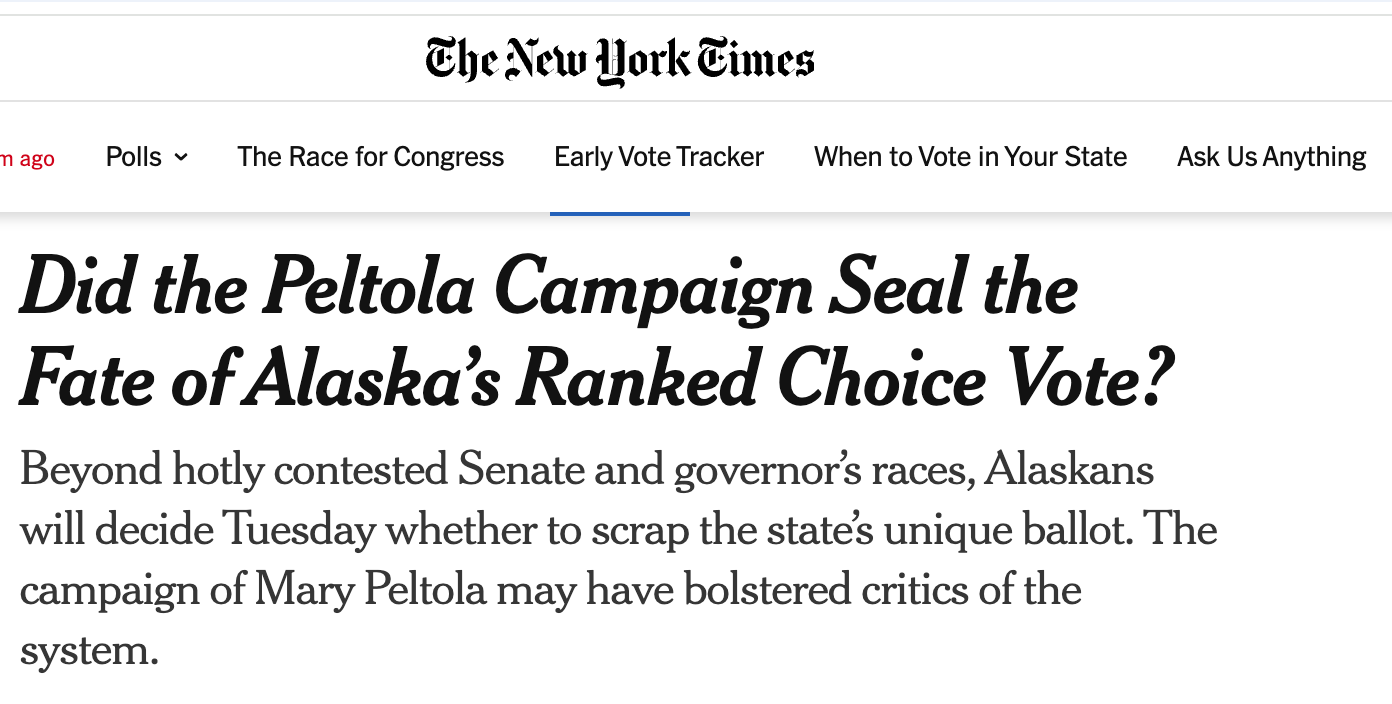
The article is full of assertions like “The campaign of Mary Peltola may have bolstered critics” of ranked choice voting. Ranked choice, the Times asserts, has been “tainted by scandal involving the recruitment of a challenger with the same name as the incumbent.” Note that these statements are not flat presentations of facts that “let readers decide” – the Times is telling readers this is a “scandal” that “taints” everything it touches. That’s a judgement, not a fact. It’s telling readers the maneuver “may have bolstered critics of the system.” That’s a judgement, not a fact.
And it’s a nonsensical judgement. Here, take a look:
Backers of the system still say it encourages bipartisanship and gives voters an extra layer of protection against dirty tricks and bogus candidates by offering multiple choices.
“This situation is actually an object lesson in why you need ranked choice voting: You can’t have a spoiler when voters have multiple options,” said Joelle Hall, a longtime labor leader working against Ballot Measure 2.
But that argument got much more difficult to make after The New York Times reported a successful effort by Democrats to recruit a candidate named Dan Sullivan to appear on the ballot alongside Senator Dan Sullivan, the incumbent Republican whom Ms. Peltola, a former Democratic House member, hopes to defeat.
This simply does not make any sense!
Ranked choice means that a voter who prefers the incumbent Republican Dan Sullivan (who, again, is the only person on the ballot who is identified as either a Republican or as the incumbent) can simply rank both Dans Sullivan 1 and 2 on the their ballot and their vote will ultimately be counted for the Republican incumbent Dan Sullivan. It is absolutely perverse for the Times to argue that this makes it “much more difficult” to argue that ranked choice helps prevent spoilers. Ranked choice very directly makes the “spoiler” Dan Sullivan far less of a spoiler than he would be if ranked choice didn’t exist. Here again the Times is not simply presenting facts and letting readers decide – it is rendering a judgement, and a nonsensical judgement at that.
Nothing about the New York Times’ handling of this has been honest. The New York Times has not been honest about what it is doing in pushing this story so hard. It has not been honest about the facts of the story. It has not been honest about whether it is making judgements or simply “letting readers decide.” And those judgements themselves are in some cases so nonsensical as to be dishonest.
Thanks for reading. Subscribing to this newsletter is free, but producing and publishing it is not. If you’d like to support my work, please consider a paid subscription.
1 The New York Times’ decision to promote Patrick Healy to “assistant managing editor for Standards and Trust” speaks volumes. Healy once (eventually) apologized for using sexist language to describe Hillary Clinton, among many other examples questionable standards and trustworthiness.
2 In an email exchange with journalist Marisa Kabas, Healy defended the Times’ decision not to report the existence of a new rape allegation against Trump. Healy’s defense was, as Kabas noted, not a very good one. I will add that Healy ignored the fact that not only did the Times choose not to tell readers about the new rape allegation, the paper described the report containing the new allegation as “largely cit[ing] allegations that have already been public,” thus actively misleading readers about the report.
3 Gardner’s defense is linguistically nonsensical as well: “Overt” means “open to view or knowledge; not concealed or secret.” A decision not to publish something can arguably be a worse “act of putting our finger on the scale” but it is certainly not a more overt act of doing so. In this case, it would have been neither.
Member discussion